
Parker County · Practical homeowner guide
Heating repair in Weatherford, TX
North Texas cold snaps expose problems that may stay hidden most of the year. Here is how Weatherford homeowners can respond safely, what we test on gas furnaces and heat pumps, and how we separate a sensible repair from a premature replacement.
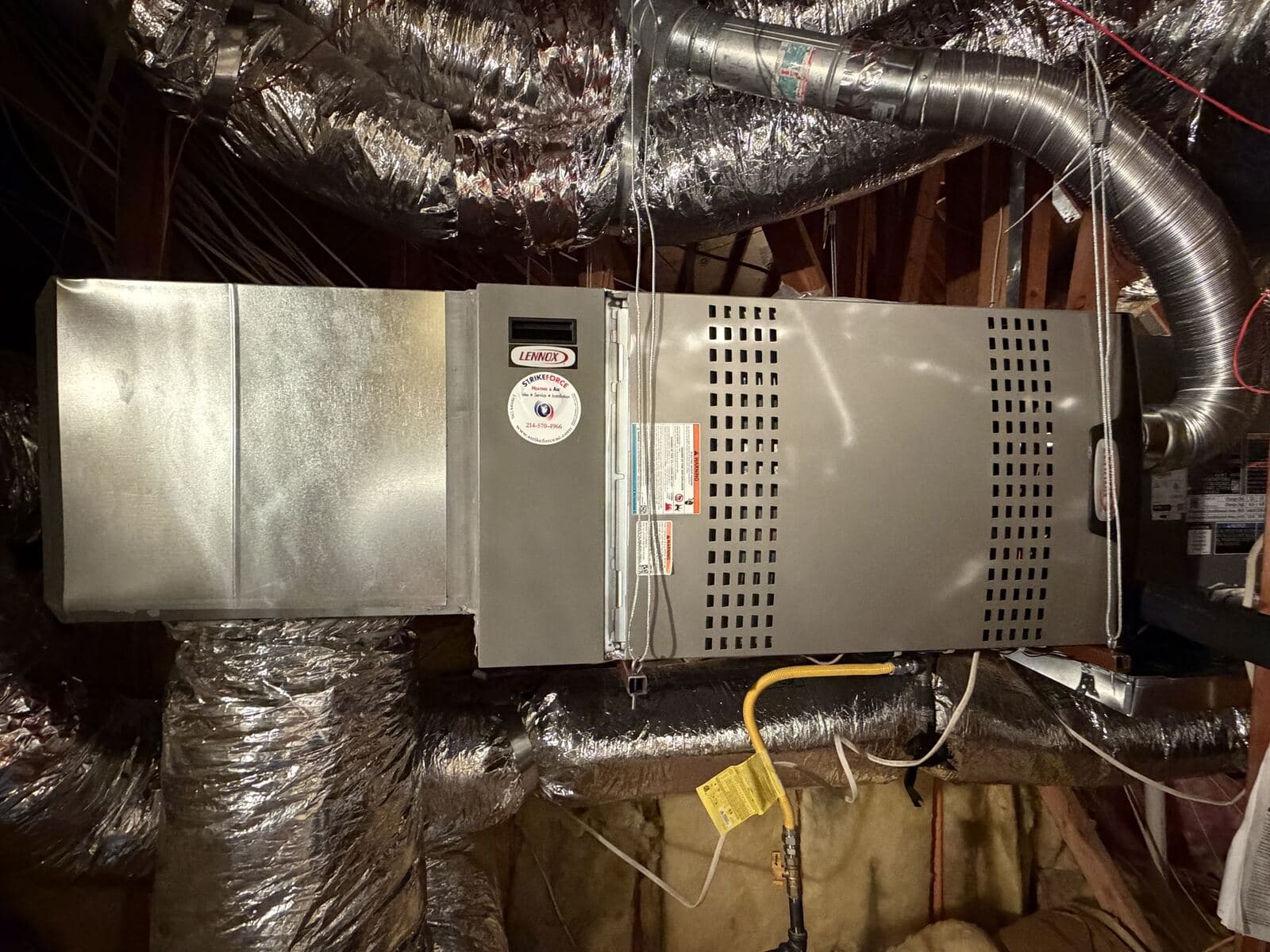
Real Strike Force heating repair work from the DFW service area. This is company job-site photography; we do not claim it was taken in Weatherford.
Weatherford context
What changes at a Weatherford home
That means utility and incentive guidance should start with the actual bill or meter address. The replacement itself should still be sized from the home and documented with complete equipment models, ducts and returns, electrical and drain scope, permit responsibility, inspection, warranty, and commissioning.
Residential changeout permit
Weatherford's online permit system identifies residential HVAC changeout under a mechanical-permit application.
More than one utility context
The City's outage resources distinguish Weatherford Electric, Oncor, and Tri-County Electric. The address and bill decide which applies.
Do not promise a rebate generically
Provider, equipment, application timing, funding, and address eligibility should be verified before an incentive appears in project economics.
Verified local administration
Permits and inspections
Weatherford's permit system identifies residential HVAC changeout as a mechanical-permit application.
Weatherford permit portal ↗Utility context
Weatherford Electric is municipal, while the City also lists Oncor and Tri-County Electric outage contacts for other addresses.
Weatherford outage center ↗Safe first steps
First: rule out a safety emergency
Leave the building and call the gas utility or 911 from a safe location if you smell gas, hear escaping gas, or a carbon-monoxide alarm sounds. Do not operate switches, use a flame, or restart equipment. Heating comfort can wait; life safety cannot.
Read the thermostat
Set Heat, raise the target temperature, and check for a low-battery warning or error message. For heat pumps, Emergency Heat is a temporary setting—not a routine fix.
Check airflow
Inspect the filter and make sure returns and supply registers are open. A furnace can shut itself down on a temperature limit when airflow is restricted.
Check power once
Confirm the furnace service switch and labeled breaker are on. Reset a tripped breaker one time only; repeated trips need diagnosis.
Protect the home during a freeze
If heat cannot be restored promptly, close blinds, keep interior doors open where plumbing needs warmth, follow local freeze guidance, and use portable heaters only according to their safety instructions.
No mystery process
What we test on a no-heat call
- 01
Identify the system and failure sequence
Gas furnaces, electric air handlers, and heat pumps fail differently. We read fault codes and watch the start sequence rather than replacing the first part that did not run.
- 02
Verify safeties and airflow
Limit switches, pressure switches, flame proving, venting, filter condition, blower performance, and temperature rise are checked as applicable.
- 03
Test the failed circuit or component
Igniters, flame sensors, inducer motors, capacitors, relays, heat strips, reversing valves, defrost controls, and thermostats are measured—not diagnosed by appearance alone.
- 04
Run and document a complete cycle
After an approved repair, we confirm safe ignition or heat-pump operation, airflow, temperature performance, and normal shutdown.
Make the decision with evidence
When repair is still the right answer
A dirty flame sensor or failed capacitor does not justify a new system. Replacement deserves discussion when safety, repeated major failures, obsolete parts, serious heat-exchanger concerns, or whole-system performance change the economics.
Gas-furnace safety
A suspected heat-exchanger or venting problem must be evaluated as a safety issue. Ask what test or visual evidence supports the finding and what operation, if any, is safe.
Heat-pump balance
High winter bills can come from excessive auxiliary heat, thermostat configuration, airflow, or a refrigeration fault—not necessarily an undersized heat pump.
Whole-system timing
Because the furnace or air handler shares a blower and cabinet with the cooling system, replacement planning should consider both halves rather than creating a mismatched system.
Keep this list
Questions worth asking any contractor
- What stage of the heating sequence is failing?
- Did you measure temperature rise and airflow?
- If there is a safety concern, what evidence supports it?
- For a heat pump, when and why is auxiliary heat running?
- How does this repair affect the rest of the matched system?
Service map
Areas we cover around Weatherford
Neighborhood names help us plan the route; they do not substitute for inspecting the house or confirming utility and permit jurisdiction by address.
Check our work
Authoritative homeowner references
These public sources support the safety, contractor-selection, sizing, and permitting guidance on this page. Local procedures can change, so we verify them again when a project is scheduled.
- U.S. Consumer Product Safety Commission: carbon monoxide safety ↗
Carbon-monoxide alarm and fuel-burning appliance safety.
- ENERGY STAR: when it is time to replace HVAC equipment ↗
Age, repair frequency, comfort, and efficiency decision factors.
- Texas Department of Licensing and Regulation: ACR contractors ↗
Texas HVAC contractor licensing and consumer information.
- Weatherford Electric Utilities ↗
Official local context used for place names and customer planning.
Straight answers
heating repair questions in Weatherford
Can I request emergency heating repair in Weatherford?
Yes. Call the emergency line and give us the exact Weatherford address so we can confirm routing and the most realistic arrival window available. During freezes, homes without heat and households with elevated health or plumbing risk receive priority.
Why does my heat pump blow air that feels cool?
Heat-pump supply air is often warm rather than furnace-hot, so it can feel cool against skin. A falling indoor temperature, continuous auxiliary heat, ice that never clears, or cold air well below room temperature merits service.
Can a furnace run after a carbon-monoxide alarm?
Do not assume the alarm is false or restart fuel-burning equipment. Move outside, call emergency services or the gas utility as directed by the alarm guidance, and have the source investigated before the system returns to service.
Ready when you are
Need heating repair in Weatherford?
Start with the symptoms. We will confirm the route, diagnose before quoting work, and explain the options in plain language.
Licensed & insured · TDLR TACLB #40686E · Family-owned since 2011